



.svg)

.svg)
.svg)
.svg)

.svg)
.svg)

The Globality Blog
Insights and articles from our procurement and sourcing experts.
Procurement leaders are under increasing pressure to define and deliver a credible AI strategy. But unlocking real value from AI in sourcing isn’t about buying another tool or layering superficial AI features onto legacy platforms that were never designed to scale.
It requires rethinking how sourcing work gets done and how procurement delivers value to the business.
AI only creates strategic impact when it is deeply embedded into day-to-day sourcing workflows. When done well, it enables teams to do more with less, improve decision quality, and expand their impactacross the enterprise. That’s why successful AI strategies focus as much on process design, governance, and operating models as they do on technology selection.
To help procurement leaders navigate this shift, our Agentic Sourcing Maturity Model identifies three levels of capability and impact. Importantly, organizations don’t need to progress through these stages sequentially. With the right technology and strategy, it’s possible to advance across multiple levels at once and dramatically accelerate time to value.
AI and automation remove friction fromroutine sourcing workflow steps: intake, event setup, supplier discovery, RFx creation, data collection, document handling, and initial scoring. Cycle times compress, bottlenecks disappear, and teams manage more spend without adding headcount.
AI brings advanced decision science into everyday sourcing workflows. Optimization, scenario analysis, and trade-off modeling are embedded directly into the process and expressed in plain languageso more professionals can confidently run sophisticated events that optimize more variables and constraints.
The result is stronger governance, higher-quality awards, and incremental value creation that compounds the efficiency gains from Stage 1. In short, decisions become systematically better, not just faster.
At the highest level of maturity, AI-driven insights allow procurement to anticipate needs, shape demand, and guide the business. Category strategies become living models informed by market signals, supplier performance, risk events, and internal demand shifts.
Procurement expands beyond cost savings to directly influence resilience, growth, and enterprise outcomes. At this stage, sourcing becomes a strategic partner, not a service function.
AI represents a once-in-a-generation opportunity to reimagine sourcing, not as a reactive cost center but as a high-impact engine for efficiency, resilience, and growth. Organizations that succeed will be those that recognize this opportunity, commit to true transformation, and select AI solutions built to change how sourcing works, not just automate pieces of it.
The biggest risk isn’t moving too fast – it’s settling for AI in name only while competitors redefine what great sourcing looks like.
Click here to download the full White Paper to explore the Agentic Sourcing Maturity Model in depth and see how to build your roadmap to sourcing success.
2025 was a landmark year for enterprises evaluating AI’s potential in the huge business arena of corporate procurement. As procurementcan account for as much as 75% of a Fortune 500 company’s total spend, anything that could potentially optimise that process deserves the Chief Procurement Officer’s serious consideration.
The experts seem to agree. McKinsey is closing the year predicting that, when done right, AI agents can make the function ‘more efficient, more agile, and increasingly strategic’. The firm says that could result in the procurement function being 25 to 40% more efficient, while repurposing team activity from routine tasks to strategic decision making. Hackett Group reported that while adoption is still in its early stages, procurement leaders expect it to provide ‘breakthrough’ levels of value, with some organisations already achieving productivity improvements of 25% or more.
In a recent webinar we ran, our customer Rhonda Spraker Griscti, Executive Director of Agile Sourcing at Bristol Myers Squibb, noted that thanks to AI, their RFP timeline had dropped from six-nine months to just 27 days and had eliminated five months of cycle time. They are now processing ten times more RFPs than before, an outcome, she said, almost unheard of in software rollouts.
Success unquestionably does depend on how you implement, integrate and use AI – not just the tech itself. So, where does this leave the market going into 2026? Fromwhere I’m sitting, it looks like AI in corporate procurement is turning out tobe a winning use case, helping to clear massive backlogs, cutting operatingexpenses, delivering ROI and even improving the function’s reputation andmorale. It’s a bold statement, so let me break down some of the specific trendsI expect to see driving this next year.
Procurement will gallop towards full automation
Procurement teams will increasingly use AI agents to do things like build and structure custom proposals, communicate with suppliers, and negotiate contracts. In the next 12 months, I predict that enterprise use of agents will resemble the speed of ChatGPT adoption thus far, moving ever closer to full automation of certain processes. Developments like the new MCP standard for AI to connect to multiple back-end data sources will be a big accelerator.
I also expect to see teams in 2026 using AI agents tonegotiate in much more personalised styles. For example, briefing an autonomous agent to adopt a more collaborative or more competitive tone, depending on the context. As autonomous negotiation becomes more mainstream, I expect this type of capability to mature significantly.
In line with McKinsey’s predictions, I believe automation will continue to help procurement teams move beyond repetitive tasksto focus on strategy and value creation. As a result, agents will have an almost immediate bottom-line impact: after all, many organisations face large backlogs of sourcing events that never receive proper analysis or negotiation. Delegating routine work to AI can help reduce that backlog, improve coverage,and give the CPO enviable levels of control over spend.
Governance and decision transparency will become key
Two aspects of transparency will gain prominence in2026. Firstly, governance transparency. Every company using AI will need to disclose how it manages these systems, including what principles guide its use, how data is handled, and what safeguards are in place. Larger enterprises are already demanding this from suppliers, sending detailed AI questionnaires and excluding those with weak or incomplete answers. To stay competitive, brands will need to clearly articulate their AI governance policies and back them up with evidence in the forms of audit trails, documentation, and verifiable architectural practices that ensure customer safety. The second aspect is decision transparency, making it clear where AI is involved in decision-making and explaining why a particular outcome occurred.
Fly those kitemarks
It’s early days in AI, but I anticipate more governance and compliance standards to start to emerge next year. From safety to privacy, companies must prove they operate at the highest levels of benchmarked competence in order to build consumer trust in their AI products and services.
Adoption is still in its early stages, but over 2026 and beyond, much like ISO 27001 did for information security, I expect ISO42001 certification to become a common badge of credibility for AI software. Full disclosure: my company is currently evaluating ISO 42001, and see real value in the framework it provides. In response to the standard, we’ve already established an AI Governance Committee, and our InfoSec team is well-versed inits requirements.
The move from generic models to vertical industry ones
Growing pressure for AI investments to deliver ROI is likely to create a sharper distinction between all-purpose LLMs and vertical industry models. As model makers attempt to monetise their offerings, I expect the pace of innovation in the former will slow, and we’ll see the incremental updates you’d expect from any evolving software. The LLMs you’ll see in 2026 are likely to hallucinate less, handle function calls better, and offer larger context windows for less reliance on retrieval-augmented generation (RAG), for example.
That’s all fine because most users are still learninghow to make the best use of the AI capabilities already available. Through 2026 and likely well into 2027, most enterprise AI progress will come from improving how we integrate and apply existing models. What might that look like? I expect enterprise AI teams to start complementing the general-purpose LLMs with smaller, specialised models that use fewer resources and are better aligned with real-world use cases. These domain-tuned models can build on the strengths of the larger ones, performing better in context because they’re trained on data grounded in actual business realities rather than broad, ungoverned internet text.
Voice will get louder
Finally, not only in procurement but across many industries and use cases, I think we’ll see a much richer set of interfaces to work with our business AIs. That could include a real shift toward using voice, and voice combined with video, for example. Younger generations Alpha and Gen Z mainly use voice to converse with Gen AI systems already. When you’re in a true verbal conversational flow with an AI, it changes how you perceive the interaction and how your brain responds to it. Just as brainstorming in-person with a whiteboard usually sparks more ideas than trading emails or chat messages, speaking with an AI can be morecreative and productive.
That could result in much better, more natural working practices. Imagine being able to ask one of your internal experts to literally verbalise what they want to go into a proposal: “Using the previous document, change to a more assertive, urgent tone. Include a reference to what we agreed in our last meeting as part of the introduction.”
If all this seems too speculative, just remember only three years ago no one had even heard of any kind of a GPT!
Procurement leaders face more pressure than ever before. From reducing costs and managing risk to driving efficiency and compliance, the modern Chief Procurement Officer (CPO) must balance competing priorities while supporting enterprise-wide growth.
At the same time, procurement is being asked to evolve – from a transactional, cost-cutting function into a strategic partner that enables innovation and long-term value creation. Achieving that transformation requires more than incremental improvements. It calls for a fundamental shift in how sourcing is executed and optimized.
That shift is being driven by Agentic AI – a new generation of autonomous sourcing technology that is revolutionizing how organizations achieve cost optimization and improve operational efficiencies.
Traditional sourcing models rely heavily on manual processes and limited visibility into data. Even the most experienced procurement teams are constrained by time, resources, and fragmented systems. As a result, organizations often leave millions in potential savings untapped.
Agentic AI-driven sourcing changes that equation. By integrating native-built sourcing expertise and intelligence throughout the entire sourcing lifecycle, it automates repetitive tasks, enhances decision-making, and identifies savings opportunities in every corner of the organization.
It’s not just about cutting costs – it’s about optimizing spend intelligently, ensuring every sourcing event contributes to strategic growth and value creation.
Cost optimization isn’t a one-time event – it’s a continuous process of identifying, capturing, and sustaining value. Agentic AI ensures that no opportunity for savings is missed by transforming how sourcing is managed across three key dimensions:
One of the most effective levers for cost optimization is ensuring that more spend is competitively bid. Autonomous sourcing powered by Agentic AI makes this seamless. By automatically setting a minimum number of vendor participants and using advanced matching technology to recommend additional qualified suppliers, Agentic AI ensures every sourcing event attracts multiple, high-quality vendor proposals. This increased competition drives better pricing, improved service levels, and greater innovation – reducing total cost of ownership and unlocking value that traditional manual sourcing simply can’t achieve.
Cost optimization doesn’t happen only through negotiation – it starts with process efficiency. Agentic AI automates sourcing workflows with robust category and region-specific rules, ensuring that every project complies with corporate policies and procurement guardrails. This automation streamlines approvals, enforces compliance, and eliminates time-consuming manual work – helping procurement teams move faster while staying aligned with organizational standards. The result: sourcing cycles that used to take weeks now take hours, or even minutes, freeing up procurement teams to focus on strategic initiatives that deliver long-term cost savings.
You can’t optimize what you can’t see. That’s why visibility into spend and supplier performance is critical to achieving sustainable cost optimization. Agentic AI-driven sourcing provides deep, real-time insights into pricing trends, supplier behavior, and category performance. It doesn’t just gather data – it analyzes it, delivering faster, richer intelligence to buyers through intuitive dashboards and visualizations. With this data-driven insight, procurement teams gain the confidence to make smarter sourcing decisions, negotiate more effectively, and drive measurable savings – all while fueling business growth.
Leading enterprises that adopt Agentic AI-driven sourcing report immediate, tangible benefits that go far beyond traditional cost reduction.
In an unpredictable global economy, cost optimization can no longer depend on manual negotiation or isolated technology tools. It requires an intelligent, autonomous system capable of learning, adapting, and acting at scale.
Agentic AI-driven sourcing represents the next frontier in procurement transformation. It brings together automation, analytics, and intelligence to deliver continuous cost optimization—ensuring every sourcing decision contributes to both immediate savings and long-term value creation.
By eliminating inefficiencies, improving visibility, and maximizing competition, Agentic AI enables organizations to take control of their spend, strengthen supplier relationships, and position procurement as a strategic advantage.
Effective cost optimization is no longer just about doing more with less – it’s about operating smarter with AI. With Agentic AI-driven sourcing, companies can achieve unprecedented efficiency, accuracy, and agility, while unlocking savings that directly impact the bottom line.
Procurement leaders who embrace this technology are not only reducing costs – they’re reshaping the future of their organizations, driving sustainable growth, and creating new value in an increasingly competitive world. Agentic AI isn’t just transforming sourcing – it’s redefining cost optimization for the enterprise of tomorrow.
2025 was a landmark year for enterprises evaluating AI’s potential in the huge business arena of corporate procurement. As procurementcan account for as much as 75% of a Fortune 500 company’s total spend, anything that could potentially optimise that process deserves the Chief Procurement Officer’s serious consideration.
The experts seem to agree. McKinsey is closing the year predicting that, when done right, AI agents can make the function ‘more efficient, more agile, and increasingly strategic’. The firm says that could result in the procurement function being 25 to 40% more efficient, while repurposing team activity from routine tasks to strategic decision making. Hackett Group reported that while adoption is still in its early stages, procurement leaders expect it to provide ‘breakthrough’ levels of value, with some organisations already achieving productivity improvements of 25% or more.
In a recent webinar we ran, our customer Rhonda Spraker Griscti, Executive Director of Agile Sourcing at Bristol Myers Squibb, noted that thanks to AI, their RFP timeline had dropped from six-nine months to just 27 days and had eliminated five months of cycle time. They are now processing ten times more RFPs than before, an outcome, she said, almost unheard of in software rollouts.
Success unquestionably does depend on how you implement, integrate and use AI – not just the tech itself. So, where does this leave the market going into 2026? Fromwhere I’m sitting, it looks like AI in corporate procurement is turning out tobe a winning use case, helping to clear massive backlogs, cutting operatingexpenses, delivering ROI and even improving the function’s reputation andmorale. It’s a bold statement, so let me break down some of the specific trendsI expect to see driving this next year.
Procurement will gallop towards full automation
Procurement teams will increasingly use AI agents to do things like build and structure custom proposals, communicate with suppliers, and negotiate contracts. In the next 12 months, I predict that enterprise use of agents will resemble the speed of ChatGPT adoption thus far, moving ever closer to full automation of certain processes. Developments like the new MCP standard for AI to connect to multiple back-end data sources will be a big accelerator.
I also expect to see teams in 2026 using AI agents tonegotiate in much more personalised styles. For example, briefing an autonomous agent to adopt a more collaborative or more competitive tone, depending on the context. As autonomous negotiation becomes more mainstream, I expect this type of capability to mature significantly.
In line with McKinsey’s predictions, I believe automation will continue to help procurement teams move beyond repetitive tasksto focus on strategy and value creation. As a result, agents will have an almost immediate bottom-line impact: after all, many organisations face large backlogs of sourcing events that never receive proper analysis or negotiation. Delegating routine work to AI can help reduce that backlog, improve coverage,and give the CPO enviable levels of control over spend.
Governance and decision transparency will become key
Two aspects of transparency will gain prominence in2026. Firstly, governance transparency. Every company using AI will need to disclose how it manages these systems, including what principles guide its use, how data is handled, and what safeguards are in place. Larger enterprises are already demanding this from suppliers, sending detailed AI questionnaires and excluding those with weak or incomplete answers. To stay competitive, brands will need to clearly articulate their AI governance policies and back them up with evidence in the forms of audit trails, documentation, and verifiable architectural practices that ensure customer safety. The second aspect is decision transparency, making it clear where AI is involved in decision-making and explaining why a particular outcome occurred.
Fly those kitemarks
It’s early days in AI, but I anticipate more governance and compliance standards to start to emerge next year. From safety to privacy, companies must prove they operate at the highest levels of benchmarked competence in order to build consumer trust in their AI products and services.
Adoption is still in its early stages, but over 2026 and beyond, much like ISO 27001 did for information security, I expect ISO42001 certification to become a common badge of credibility for AI software. Full disclosure: my company is currently evaluating ISO 42001, and see real value in the framework it provides. In response to the standard, we’ve already established an AI Governance Committee, and our InfoSec team is well-versed inits requirements.
The move from generic models to vertical industry ones
Growing pressure for AI investments to deliver ROI is likely to create a sharper distinction between all-purpose LLMs and vertical industry models. As model makers attempt to monetise their offerings, I expect the pace of innovation in the former will slow, and we’ll see the incremental updates you’d expect from any evolving software. The LLMs you’ll see in 2026 are likely to hallucinate less, handle function calls better, and offer larger context windows for less reliance on retrieval-augmented generation (RAG), for example.
That’s all fine because most users are still learninghow to make the best use of the AI capabilities already available. Through 2026 and likely well into 2027, most enterprise AI progress will come from improving how we integrate and apply existing models. What might that look like? I expect enterprise AI teams to start complementing the general-purpose LLMs with smaller, specialised models that use fewer resources and are better aligned with real-world use cases. These domain-tuned models can build on the strengths of the larger ones, performing better in context because they’re trained on data grounded in actual business realities rather than broad, ungoverned internet text.
Voice will get louder
Finally, not only in procurement but across many industries and use cases, I think we’ll see a much richer set of interfaces to work with our business AIs. That could include a real shift toward using voice, and voice combined with video, for example. Younger generations Alpha and Gen Z mainly use voice to converse with Gen AI systems already. When you’re in a true verbal conversational flow with an AI, it changes how you perceive the interaction and how your brain responds to it. Just as brainstorming in-person with a whiteboard usually sparks more ideas than trading emails or chat messages, speaking with an AI can be morecreative and productive.
That could result in much better, more natural working practices. Imagine being able to ask one of your internal experts to literally verbalise what they want to go into a proposal: “Using the previous document, change to a more assertive, urgent tone. Include a reference to what we agreed in our last meeting as part of the introduction.”
If all this seems too speculative, just remember only three years ago no one had even heard of any kind of a GPT!
AI-driven sourcing finds cost savings and creates new business value in every corner of the organization. This cost optimization isn’t a one-off event – it’s a continuous process of identifying, capturing, and sustaining value. At the heart of this strategy lies Agentic AI, which ensures that no opportunity for savings is missed at any stage of the sourcing process from intake to award. To maximize the benefits from this transformative technology, follow these three tips:
One of the most effective cost savings strategies for procurement is ensuring that more spend is competitively bid. Autonomous sourcing powered by Agentic AI makes this seamless. By automatically setting a minimum number of vendor participants and using advanced matching technology to recommend additional qualified suppliers, Agentic AI ensures every sourcing event attracts multiple, high-quality vendor proposals. This increased competition drives better pricing, improved service levels, and greater innovation – reducing total cost of ownership and unlocking value that traditional manual sourcing simply can’t achieve.
Cost saving strategies should start with process efficiency. Agentic AI automates sourcing workflows with robust category and region rules ensuring that every project complies with corporate policies and procurement guardrails. This automation streamlines approvals, enforces compliance, and eliminates time-consuming manual work – helping procurement teams move faster while staying aligned with organizational standards. The result: sourcing cycles that used to take weeks now take hours, or even minutes, freeing up procurement teams to focus on strategic initiatives that deliver long-term cost savings.
Increasing visibility into spend and supplier performance is critical to achieving sustainable cost optimization. Agentic AI-driven sourcing provides deep, real-time insights into pricing trends, supplier behavior, and category performance. It doesn’t just gather data – it analyzes it, delivering faster, richer intelligence to buyers through intuitive dashboards and visualizations. With this data-driven insight, procurement teams gain the confidence to make smarter sourcing decisions, negotiate more effectively, and drive measurable savings – all while fueling business growth.
Procurement leaders face more pressure than ever before. From reducing costs and managing risk to driving efficiency and compliance, the modern Chief Procurement Officer (CPO) must balance competing priorities while supporting enterprise-wide growth.
At the same time, procurement is being asked to evolve – from a transactional, cost-cutting function into a strategic partner that enables innovation and long-term value creation. Achieving that transformation requires more than incremental improvements. It calls for a fundamental shift in how sourcing is executed and optimized.
That shift is being driven by Agentic AI – a new generation of autonomous sourcing technology that is revolutionizing how organizations achieve cost optimization and improve operational efficiencies.
Traditional sourcing models rely heavily on manual processes and limited visibility into data. Even the most experienced procurement teams are constrained by time, resources, and fragmented systems. As a result, organizations often leave millions in potential savings untapped.
Agentic AI-driven sourcing changes that equation. By integrating native-built sourcing expertise and intelligence throughout the entire sourcing lifecycle, it automates repetitive tasks, enhances decision-making, and identifies savings opportunities in every corner of the organization.
It’s not just about cutting costs – it’s about optimizing spend intelligently, ensuring every sourcing event contributes to strategic growth and value creation.
Cost optimization isn’t a one-time event – it’s a continuous process of identifying, capturing, and sustaining value. Agentic AI ensures that no opportunity for savings is missed by transforming how sourcing is managed across three key dimensions:
One of the most effective levers for cost optimization is ensuring that more spend is competitively bid. Autonomous sourcing powered by Agentic AI makes this seamless. By automatically setting a minimum number of vendor participants and using advanced matching technology to recommend additional qualified suppliers, Agentic AI ensures every sourcing event attracts multiple, high-quality vendor proposals. This increased competition drives better pricing, improved service levels, and greater innovation – reducing total cost of ownership and unlocking value that traditional manual sourcing simply can’t achieve.
Cost optimization doesn’t happen only through negotiation – it starts with process efficiency. Agentic AI automates sourcing workflows with robust category and region-specific rules, ensuring that every project complies with corporate policies and procurement guardrails. This automation streamlines approvals, enforces compliance, and eliminates time-consuming manual work – helping procurement teams move faster while staying aligned with organizational standards. The result: sourcing cycles that used to take weeks now take hours, or even minutes, freeing up procurement teams to focus on strategic initiatives that deliver long-term cost savings.
You can’t optimize what you can’t see. That’s why visibility into spend and supplier performance is critical to achieving sustainable cost optimization. Agentic AI-driven sourcing provides deep, real-time insights into pricing trends, supplier behavior, and category performance. It doesn’t just gather data – it analyzes it, delivering faster, richer intelligence to buyers through intuitive dashboards and visualizations. With this data-driven insight, procurement teams gain the confidence to make smarter sourcing decisions, negotiate more effectively, and drive measurable savings – all while fueling business growth.
Leading enterprises that adopt Agentic AI-driven sourcing report immediate, tangible benefits that go far beyond traditional cost reduction.
In an unpredictable global economy, cost optimization can no longer depend on manual negotiation or isolated technology tools. It requires an intelligent, autonomous system capable of learning, adapting, and acting at scale.
Agentic AI-driven sourcing represents the next frontier in procurement transformation. It brings together automation, analytics, and intelligence to deliver continuous cost optimization—ensuring every sourcing decision contributes to both immediate savings and long-term value creation.
By eliminating inefficiencies, improving visibility, and maximizing competition, Agentic AI enables organizations to take control of their spend, strengthen supplier relationships, and position procurement as a strategic advantage.
Effective cost optimization is no longer just about doing more with less – it’s about operating smarter with AI. With Agentic AI-driven sourcing, companies can achieve unprecedented efficiency, accuracy, and agility, while unlocking savings that directly impact the bottom line.
Procurement leaders who embrace this technology are not only reducing costs – they’re reshaping the future of their organizations, driving sustainable growth, and creating new value in an increasingly competitive world. Agentic AI isn’t just transforming sourcing – it’s redefining cost optimization for the enterprise of tomorrow.
John Paterson, former Chief Procurement Officer at IBM, once described the relationship between the CFO and the CPO “the most important relationship that exists or needs to exist within the enterprise.”
Back in 2014, he was absolutely right. He was also right when he acknowledged that this relationship has often been fraught with tension. And, unfortunately, the progress made since then has been minimal.
Why? Because if you’re a CPO, it can be a struggle to always make your voice heard. People recognize that procurement handles various tasks, delivers savings, sources categories, manages risk and compliance and improves supplier costs. However, the CFO often struggles to see these efforts reflected in tangible positive changes on the P&L.
The reality is that the connectivity between budgets and budgeting and procurement—in other words, between FP&A and procurement—is sub-optimized. As a result, if a company sets a $73 million budget for the Chief Marketing Officer (CMO) and procurement helps save $3 million, the CMO will still end up spending the entire $73 million. In an early outsourcing deal, finance essentially said to us, "I'm just tired of procurement telling me how many auctions they ran and how much savings they generated because I never see this in the P&L!"
This also happens because procurement is not brought into the process until the last minute. Procurement should be an enabler to achieve the same or more with a smaller budget, but this often doesn’t happen because the business sees the procurement function as a blocker. A significant portion of procurement's day involves someone coming to them and saying, "I need you to finalize this deal for me; I've already figured it out."
Procurement then asks, "What process did you follow, and what evidence do you have for choosing that supplier?" The response is more often than not along the lines of, "I don't have any, but I'm in a rush—so just do it." Further, even when procurement is involved early in the decision-making process, the loop is not closed with the FP&A budgeting process, allowing value to be re-spent without much rigor or governance.
As it stands, then, there's little reason for the CFO to prioritize this relationship. As John Paterson pointed out years ago, both the CFO and the CPO have the best interests of the business at heart, but they can't always agree on how “best” is operationalized and managed from the beginning of a buying process, through to budget governance.
However, the good news is, there's a way to make the value generated by procurement visible in the P&L and get this relationship back on track. What is needed is a mechanism to finally get some real visibility into spending. If a business needs to generate cost savings, as many do right now, they should reduce the budgets and then involve procurement to ensure that departments like Marketing and IT still get everything they need, but with a 10% lower budget or whatever reduction makes the most sense.
Realistically, that’s only going to happen if we move closer to true zero-based budgeting. This approach involves asking each year what the business needs to achieve and then building the budget from zero, based on what is required to meet those goals.
If we adopted this approach—driven by the AI-powered autonomous sourcing that many of our customers are implementing—procurement and finance would establish a strong and cohesive relationship. For instance, at UK retail giant Tesco, a new “Spend to Invest” plan exemplifies this. Procurement generated £645 million ($823 million) in value, which the CFO then reinvested to enhance pricing power and expand into new countries, regions, and business lines.
And in the case of global investment management leader T. Rowe Price, a new approach to procurement using AI has helped increase the function’s internal visibility and therefore its standing with finance.
According to its Chief Procurement Officer, Harold Wu, every member of its management are now big supporters of the discipline. As a result, the firm, was able to generate more than $40 million in operational savings. As he says, “If you're able to increase the value, that gets noticed.”
Using AI to create a clear link between cost reduction efforts and increased budget and working capital for your organization? Sounds like a C-suite individual destined for success!
To truly unlock the value of procurement, CPOs must transcend traditional boundaries and align closely with their counterparts in the C-suite, particularly the CFO, impressing upon them the need to invest in AI-powered digital platforms to drive new efficiencies and cost savings.
However, the challenge lies in securing the necessary funding to implement these technologies, particularly when the benefits of procurement’s initiatives are often realized in other departments’ budgets.
In conversation with Eric Shaver, Managing Partner at Kinsei Partners, on the latest Spend Sessions podcast, I discussed how procurement leaders can obtain the funds they need to invest in game-changing digital technology by better communicating the value that sourcing teams bring to the business.
1. Speak the CFO’s LanguageCPOs face the daunting task of convincing CFOs to allocate funds for procurement technologies that will yield savings across the organization. Eric emphasizes that this conversation needs to shift from a budget request to a strategic discussion about enterprise-wide value. CFOs are focused on optimizing operating cash flow, free cash flow, and ultimately, shareholder value. Therefore, CPOs must frame their technology investments not as procurement tools, but as operational assets that will drive margin improvement and enhance the company’s financial performance.
2. Build a Compelling Business CaseA critical step for CPOs is to construct a robust business case that resonates with the CFO’s priorities. This involves demonstrating how procurement technology can optimize key financial metrics, such as EBITDA margin and working capital. For example, by reducing indirect spend, CPOs can have a direct impact on SG&A expenses, which in turn improves EBITDA. Similarly, effective procurement strategies can shorten the cash conversion cycle, freeing up capital that can be reinvested in the business.
Eric suggests that CPOs should leverage financial modeling to highlight the projected impact of these technologies on the company’s bottom line. It’s not enough to be conservative—CPOs must present the most accurate and comprehensive case possible, including all potential savings and efficiencies. In doing so, they demonstrate that their initiatives are not just cost centers but are strategic investments that contribute to the company’s overall financial health.
3. Embrace the Role of AI in ProcurementArtificial Intelligence (AI) is a game-changer in the procurement space, offering unprecedented opportunities to optimize sourcing, improve supplier negotiations, and streamline processes. Eric describes AI as a “force multiplier,” capable of dramatically increasing efficiency and decision-making speed. However, the key to successfully integrating AI into procurement lies in convincing the CFO of its value.
AI’s potential to enhance procurement is significant, but it requires upfront investment. Here again, the CPO must make a compelling case to the CFO, showing how AI can drive enterprise-wide benefits. Whether it’s through improved supplier management, enhanced demand forecasting, or automated workflows, AI can help procurement teams deliver measurable financial results.
4. Position Procurement as a Strategic Asset
One of the biggest challenges CPOs face is overcoming the perception that procurement technology is a non-essential expense. As Eric points out, procurement is often mislabeled as a back-office function, when in reality, it has the potential to influence every aspect of the business. By positioning procurement technology as an operational asset rather than a procurement tool, CPOs can shift the conversation from cost to value creation.
This repositioning is crucial in the current economic climate, where rising interest rates and the cost of capital are squeezing margins. CPOs who can demonstrate how their initiatives will optimize free cash flow and improve return on invested capital will find it easier to secure the necessary funding.
Final Thoughts: The Path Forward
For CPOs, the path to success lies in deepening their financial fluency and aligning their goals with those of the CFO and the broader C-suite. By presenting procurement initiatives as strategic investments that drive enterprise-wide value, CPOs can secure the funding they need to implement the digital tools that will transform their function.
Eric’s advice is clear: don’t shy away from the financials. Understand how your initiatives impact the company’s key metrics, build a strong business case, and position procurement as a strategic asset that drives shareholder value. In doing so, CPOs can not only secure the funding they need but also elevate their role within the organization, becoming true partners in driving business success.
Click here
The office of the CFO has traditionally had six functions, or areas of business, that together form the work and tasks of the finance team. Each area has built up an accompanying technology stack with increasing levels of automation being injected into processes as finance leaders strive for new efficiencies and cost reductions while increasing governance and control to improve risk management.
Across each function, new software from innovative vendors has become popular with CFOs as they’ve seized on the imperative to automate repetitive, low-value tasks and free up their teams to focus on more strategic work that creates opportunities for enterprise investment and growth.
But what many CFOs don’t realize is that there is now, in fact, a seventh area of business within their office and that this function offers the biggest and quickest opportunity to deliver improved productivity and increased efficiencies through the use of AI-driven automation – the chance to pick the lowest-hanging fruit and demonstrate immediate ROI on investment in new technology.
Spend management refers to every dollar a company pays out for goods and services but is often overlooked and hidden away in a dark corner of procurement. Effective spend management helps to ensure that every expenditure is necessary, strategic, and provides value to the company. It also involves analyzing spending patterns, identifying inefficiencies, and making adjustments to improve financial performance.
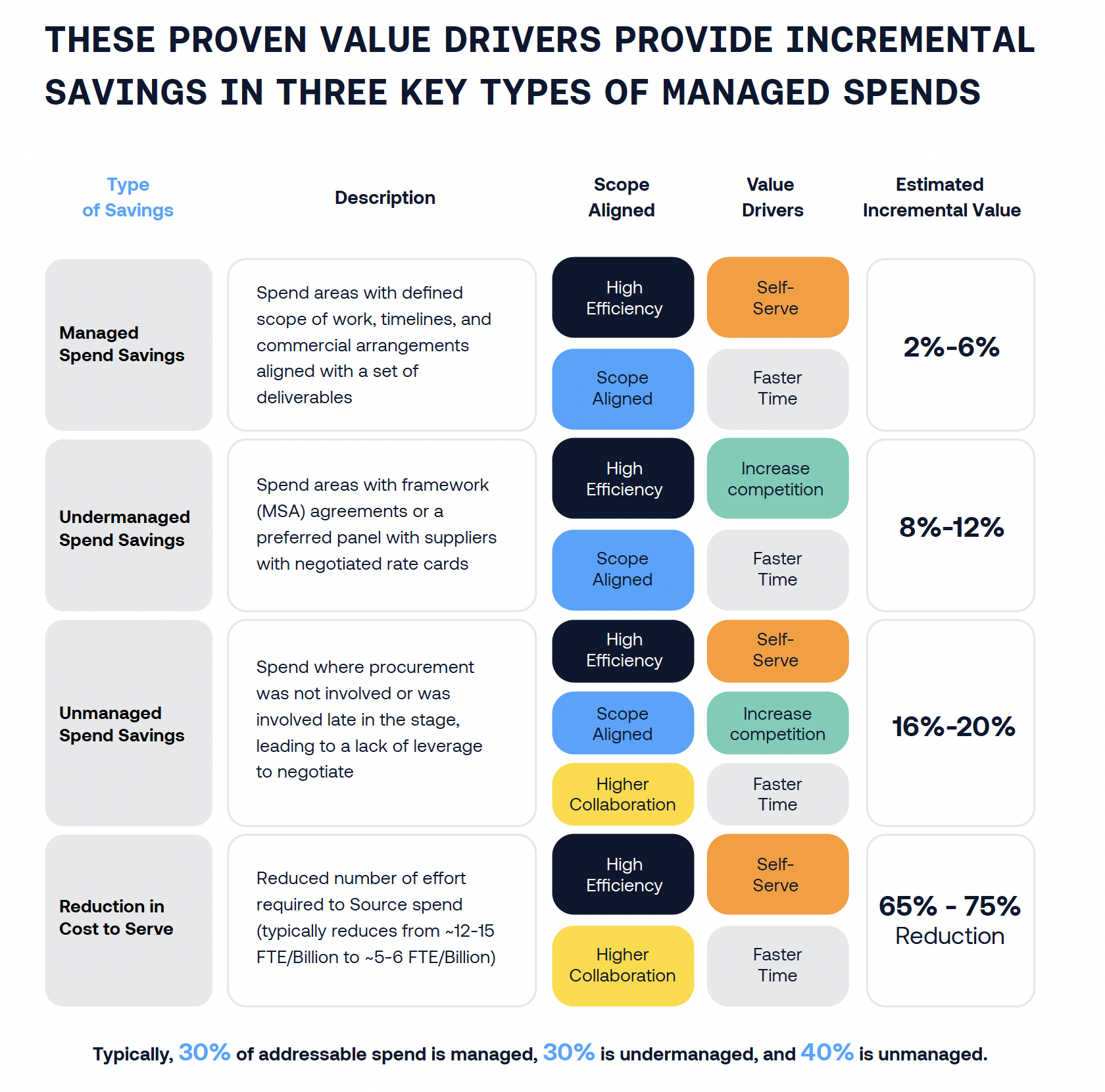
If a CFO brings more of their company’s spend under management, instead of allowing the business to bypass procurement with ‘rogue’ or ‘maverick’ spend then not only will they see 10-20% cost savings due to increased supplier competition, but cycle times will reduce by up to 90% as slow manual processes are automated.
Using automated spend management technology such as Globality, global enterprise companies can reduce the RFX process from 3-6 months to 27-35 days on average. This dramatic increase in speed and efficiency comes at all stages of the purchasing journey.
With AI-driven autonomous sourcing, the business user can still lead the process and include their preferred suppliers. However, within rules and guardrails set in place by procurement that will enhance competition and improve compliance and risk management by ensuring all purchases adhere to company policies.
Reducing the sourcing cycle from 3-6 months to 27-35 days
Engagement Initiation (Was 1 week, Now 1 day)
Supplier Information & Requirement Gathering (Was 2-6 weeks, Now 2-3 days)
RFx quotation phase (Was 2-4 weeks, Now 8-10 days)
Quote Evaluation (Was 2-4 weeks, Now 2-3 days)
Presentation (Was 2-4 weeks, Now 5-8 days)
Contracting Stage (Was 1-6 months, Now 3-5 days)
RFx Close Out (Was 1-2 weeks, Now 1-2 days)
In many cases, G2000 companies are enjoying even greater efficiencies than those listed above. Iconic UK-based telecoms provider BT reduced its cycle time to market from seven to ten days down to just one day and reported this substantial efficiency gain in its 2024 Annual Report.
These figures were based on more than 1000 projects sourced on Globality’s AI-driven platform across nearly £8bn of spend so represent substantial new value to the business.
“We are now using generative AI so that our teams just have to type one sentence and the generative AI will help them along to do everything all the way to engaging with suppliers. It has super simplified the whole process,” says Cyril Pourrat, BT’s Chief Procurement Officer.
In addition to those speed to market improvements, BT has enjoyed double-digit savings across that spend as users collaborated with colleagues and suppliers and significantly reduce costs through increased competition, data-driven insights, and intelligent analysis.
Similarly, one of the world’s most recognizable sporting goods brands has adopted autonomous sourcing and its business users now self-serve for all events up to $3m with no involvement from procurement whatsoever. That has freed up 30 people from its Business Process Outsourcing office to work on other, higher-value projects – huge value to the company.
In an era where every dollar counts, especially in the face of economic uncertainties, managing spend more effectively can unlock significant value for a company, directly impacting its bottom line and bridging the gap between finance, procurement, and overall corporate strategy.
Adding spend management as the seventh function of the CFO office is not just a necessity; it’s an opportunity for CFOs to drive greater value for their organizations. The scope of their responsibilities has expanded beyond traditional financial management and CFOs are now strategic partners in business decision-making, playing a crucial role in driving growth and innovation.
Click here to book a demo of our award-winning AI-driven spend management platform.